Hair Restoration · Physician-Supervised
Hair Transplant Surgery & Restoration
Permanent hair restoration through advanced surgical transplantation techniques. Natural-looking results for male and female pattern hair loss with physician-supervised comprehensive care and long-term follow-up.
Hair transplant surgery at Berens MD – Concierge Healthcare & Wellness is approached thoughtfully and conservatively with 35+ years of medical experience. Dr. Berens provides comprehensive consultations, medical oversight, and coordinates with leading hair restoration surgeons for optimal outcomes.
Hair transplantation involves moving hair follicles from donor areas (typically the back and sides of the scalp where hair is genetically resistant to balding) to areas of thinning or baldness. Modern techniques including FUE (Follicular Unit Extraction) and FUT (Follicular Unit Transplantation) create natural-looking hairlines with predictable, permanent results.
This is a significant medical decision requiring thorough evaluation of your hair loss pattern, medical history, realistic expectations, and long-term maintenance plan. Dr. Berens ensures you understand all aspects of the procedure, candidacy requirements, timeline for results, and whether surgical or non-surgical approaches (or combination therapy) are most appropriate for your individual situation.
Hair Transplant & Restoration Results
Before and after surgical hair restoration coordinated by Dr. Berens
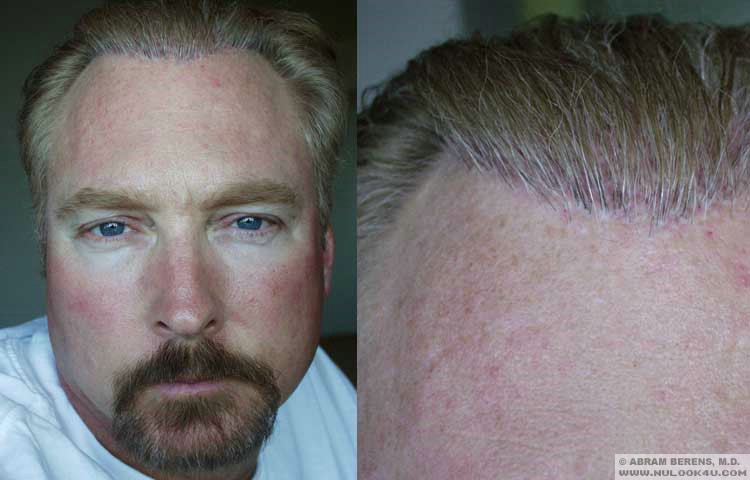
FUE Hair Transplant – Male Pattern Baldness (Frontal View & Hairline Detail)
Before and after results of FUE (Follicular Unit Extraction) hair transplant in a male patient with Norwood Type III-IV male pattern baldness presenting with frontal hairline recession and decreased density in the frontal-temporal region. The patient exhibited characteristic androgenetic alopecia (male pattern baldness) with miniaturization of hair follicles in the frontal scalp and bitemporal recession creating an M-shaped hairline. The before images show significant visible scalp in the frontal region, receded temporal points, and thin, wispy hair along the existing hairline. Using the FUE technique, individual follicular units were extracted from the occipital (back of scalp) donor area and strategically transplanted to recreate a natural, age-appropriate hairline with proper density and distribution. The after images demonstrate excellent graft survival with natural hair growth pattern, restored frontal density, and a hairline that follows natural anatomic landmarks with appropriate temporal recession to avoid an overly aggressive or artificial appearance. The close-up hairline view shows the meticulous single-hair grafts placed along the frontal edge to create a soft, natural transition (rather than a “pluggy” or linear appearance characteristic of older hair transplant techniques). Approximately 2,000-2,500 grafts were transplanted in this single session. The patient was also maintained on medical therapy (finasteride/Propecia® and minoxidil) to preserve native (non-transplanted) hair and optimize long-term results. These results represent 12-14 months post-surgery when final density and maturation are achieved. This case demonstrates the transformative potential of modern FUE hair transplantation performed by experienced surgeons with physician oversight for comprehensive medical management including prevention of further hair loss.
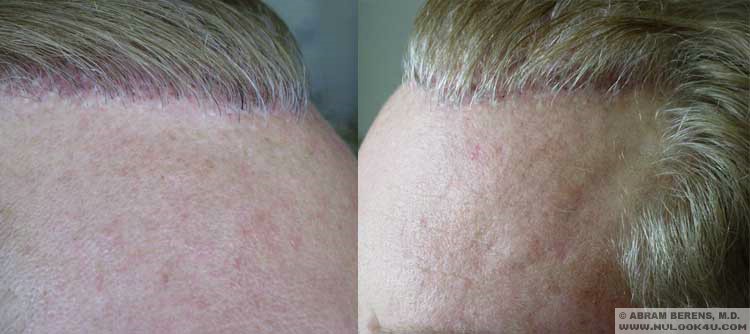
FUE Hair Transplant – Frontal Hairline Restoration (Close-Up Detail)
Close-up before and after comparison focusing on the frontal hairline region, demonstrating the precision and artistry of modern FUE hair transplantation. The before image shows a significantly receded hairline with visible scalp exposure, miniaturized hairs (telltale sign of androgenetic alopecia where hair follicles progressively shrink and produce thinner, shorter hairs), and lack of frontal density creating an aged appearance. The after image showcases the meticulous reconstruction of a natural hairline with careful attention to multiple critical factors: (1) appropriate hairline positioning that respects the patient’s age, facial proportions, and frontal-temporal angles to avoid an unnatural or “pluggy” result, (2) strategic use of single-hair follicular unit grafts along the leading edge of the hairline to create a soft, irregular transition mimicking natural hair growth patterns, (3) gradual increase in density moving from the hairline backwards with 2-3 hair grafts behind the frontal edge to establish fullness, and (4) proper hair angulation and direction to ensure transplanted hair lies naturally and can be styled normally. This level of detail requires both surgical expertise and artistic judgment. The visible grafts show excellent “take rate” (survival) with healthy hair shafts growing at proper angles. The natural appearance is achieved by avoiding the outdated “doll’s hair” look of older plug techniques. This patient received approximately 1,500-1,800 grafts focused on the frontal zone in a single FUE session lasting 6-7 hours under local anesthesia. Donor area scarring is minimal with FUE technique (tiny dot scars barely visible even with short hair). Post-operative care included gentle washing protocols, avoidance of physical trauma, and medical therapy to protect native hair. Results shown are at 12+ months when transplanted follicles have completed their growth cycle and achieved full maturation.
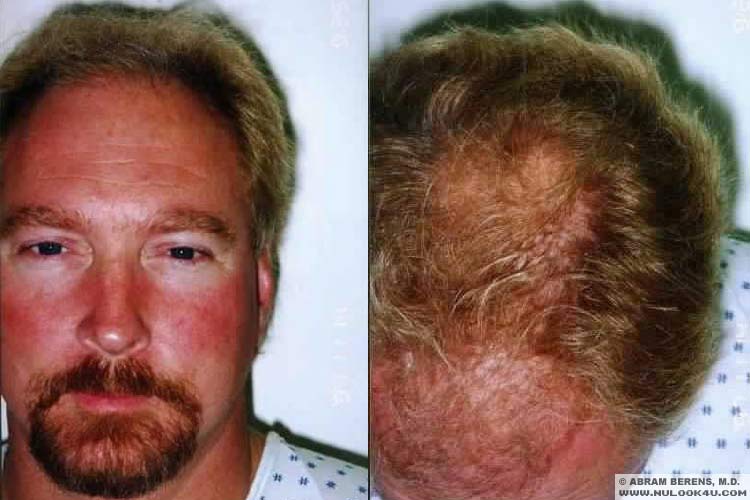
Comprehensive Hair Restoration – Frontal & Crown Zones (Multi-View Documentation)
Before and after multi-angle documentation of comprehensive hair restoration in a male patient with advanced male pattern baldness affecting both the frontal-temporal region and vertex (crown) area, representing Norwood Type IV-V classification. This patient presented with significant hair loss requiring extensive grafting to achieve meaningful improvement. The frontal view demonstrates restoration of a natural hairline with proper positioning and density, while the crown/vertex view shows strategic graft placement to provide coverage in this challenging area. Crown restoration is technically demanding because: (1) it requires a large number of grafts to create adequate density over the circular balding area, (2) hair must be angled properly to radiate from the vertex whorl in a natural spiral pattern, (3) it’s highly visible from above and behind, making poor technique immediately apparent, and (4) the crown area has lower blood supply making graft survival slightly less predictable compared to the frontal scalp. This patient underwent a large session FUE procedure transplanting approximately 3,000-3,500 grafts distributed strategically between the frontal zone (hairline and frontal-temporal areas) and the crown/vertex region. The procedure was performed over two days (staged procedure) to minimize patient discomfort and optimize graft handling time, which is critical for follicle survival. The after images show excellent density restoration in both treated areas with natural hair growth direction and appropriate coverage that significantly improves cosmetic appearance when viewed from all angles. The patient maintains concurrent medical therapy with finasteride (Propecia®) to prevent further loss of native (non-transplanted) hair in the mid-scalp transition zone between grafted areas. This case illustrates the importance of comprehensive planning, adequate donor hair availability, realistic expectations about coverage versus density in large areas, and the critical role of continued medical management. Results shown represent 14-16 months post-surgery with full growth and maturation of transplanted follicles.
Important: Individual results vary significantly based on the extent of hair loss, quality and quantity of donor hair, patient age, hair characteristics (texture, color, curl), skin tone, healing capacity, and surgical technique. Hair transplantation is a medical procedure with inherent limitations and potential risks including poor graft survival, infection, scarring, unnatural appearance if improperly performed, and continued hair loss in non-transplanted areas. Multiple procedures may be required to achieve desired density. Realistic expectations are critical—hair transplantation redistributes existing hair rather than creating new hair. Ongoing medical therapy (finasteride, minoxidil) is typically recommended to preserve native hair and optimize long-term results.
Image Disclosure: Some images displayed on this website are AI-generated and are used solely for illustrative purposes. No real patients are shown in AI-generated images. This approach is used to protect patient privacy and comply with applicable privacy standards, including HIPAA. Individual treatment results vary based on personal health factors and medical conditions. Outcomes shown or described are not guaranteed. All medical and aesthetic services are provided in accordance with Florida law and require an individualized consultation with a licensed healthcare provider.
Hair Transplant Techniques: FUE vs. FUT
Modern hair transplant surgery offers two primary surgical approaches, each with distinct advantages, limitations, and appropriate indications. Dr. Berens will discuss which technique is most suitable based on your hair loss pattern, goals, donor hair characteristics, lifestyle, and aesthetic preferences.
FUE (Follicular Unit Extraction)
Individual follicular units are extracted one-by-one directly from the donor area using a small punch instrument (0.8-1.0mm diameter). This creates tiny circular scars that are virtually undetectable, even with very short hairstyles. FUE allows for selective harvesting of the best quality follicles and faster patient recovery with minimal discomfort. Modern robotic and manual FUE techniques have dramatically improved graft quality and procedure efficiency.
Advantages: No linear scar, minimal post-operative discomfort, faster healing (5-7 days), ability to wear hair very short, can harvest from body hair if needed (chest, beard) for extensive procedures, less invasive technique.
Limitations: More time-consuming (longer procedure), slightly higher cost per graft, transection rate (damage to follicles during extraction) slightly higher than FUT in less experienced hands.
Best For: Patients wanting to wear hair short, active lifestyles, those concerned about visible scarring, smaller to medium-sized procedures (500-2,500 grafts), patients with tight scalp (limited laxity).
FUT (Follicular Unit Transplantation / Strip Method)
A strip of hair-bearing scalp is surgically removed from the donor area (typically 1-1.5cm wide by 15-25cm long depending on scalp laxity and graft needs). The strip is then dissected under microscopes into individual follicular unit grafts by a specialized team. This allows harvesting of large numbers of grafts in a single session with excellent follicle quality and minimal transection. The donor area is closed with sutures resulting in a thin linear scar hidden by surrounding hair.
Advantages: Maximum number of grafts in single session (up to 3,500-4,000+ grafts), excellent graft quality with minimal transection, less expensive per graft, faster extraction of large numbers, ideal for extensive coverage needs.
Limitations: Linear scar in donor area (requires hair length to cover), longer healing time (10-14 days for suture removal), more post-operative discomfort, tightness sensation during healing.
Best For: Extensive hair loss requiring maximum grafts (Norwood Type V-VII), patients willing to maintain longer hair in donor area, those prioritizing graft numbers and cost-efficiency, mega-sessions for dramatic transformation.
Combination Approach: Some patients benefit from FUT for initial large-volume restoration followed by FUE for refinement or additional density in subsequent procedures. Dr. Berens provides comprehensive evaluation to recommend the optimal strategy for your individual needs and long-term hair restoration goals.
Hair Transplant Treatment Process
1. Comprehensive Evaluation
Dr. Berens evaluates your hair loss pattern (Norwood or Ludwig classification), donor hair availability and quality, scalp laxity, medical history, and discusses realistic expectations. Review of surgical vs. non-surgical options and combination approaches.
2. Surgical Planning
Hairline design, graft distribution planning, technique selection (FUE vs. FUT), and coordination with specialized hair restoration surgeon. Pre-operative instructions and medical clearance if needed.
3. Surgical Procedure
Hair follicles harvested from donor area and meticulously transplanted to treatment zones. Performed under local anesthesia. Procedure duration: 4-8 hours (FUE) or 6-10 hours (large FUT sessions). Coordinated by Dr. Berens with specialized surgical team.
4. Growth & Maintenance
Transplanted hair sheds in weeks 2-4 (normal shock loss). New growth begins month 3-4. Significant results at 6-9 months. Final density at 12-18 months. Dr. Berens provides ongoing medical support, maintenance therapy, and surveillance.
Benefits of Hair Transplant Surgery
Permanent, natural-looking results that last a lifetime
Uses your own hair (no rejection or allergic reactions)
Modern FUE technique with minimal scarring
Restores natural hairline and frontal density
Significantly boosts confidence and self-esteem
Can wear hair short with FUE technique
Natural hair growth that can be cut, styled, dyed
One-time procedure (additional sessions optional)
Physician-supervised comprehensive care
Coordination with specialized hair restoration surgeons
Long-term medical support and maintenance planning
Combination with medical therapy (finasteride, minoxidil)
No ongoing maintenance required for transplanted hair
Predictable results when performed by experts
Cost-effective long-term compared to temporary solutions
Addresses both medical and cosmetic concerns
Benefits of Hair Transplant Surgery
Men with male pattern baldness (androgenetic alopecia) Norwood Type III-VII
Women with female pattern hair loss (Ludwig Scale I-III)
Individuals with adequate donor hair density and quality
Patients with stable hair loss pattern (not rapidly progressive)
Those seeking permanent hair restoration solution
Individuals with realistic expectations about results and limitations
Patients in good general health with no contraindications
Those committed to post-operative care and medical maintenance
Individuals willing to wait 12-18 months for final results
Patients interested in natural-looking outcomes
Those who have tried or are using medical therapy (finasteride, minoxidil)
Individuals with sufficient scalp laxity (for FUT) or adequate donor area (for FUE)
Patients seeking physician-supervised comprehensive care
Those with hair loss causing significant psychological distress
Important Note: Not all hair loss is suitable for transplantation. Dr. Berens will evaluate for underlying medical causes (thyroid disease, nutritional deficiencies, autoimmune conditions, medications) that require treatment before considering surgery. Patients with diffuse unpatterned hair loss (DUPA), active scalp conditions, or unrealistic expectations may not be good candidates.
Frequently Asked Questions
Am I a good candidate for hair transplant surgery?
Good candidates have sufficient donor hair (back and sides of scalp), stable or slowly progressive hair loss pattern, and realistic expectations about achievable density and coverage. Dr. Berens will evaluate your Norwood or Ludwig classification, donor hair quality, scalp laxity, and overall health during consultation. Some patients benefit from medical therapy first (finasteride/Propecia®, minoxidil/Rogaine®, PRP treatments) to stabilize hair loss before surgery, while others are ready for immediate transplantation. Combination approaches (medical + surgical) often provide optimal long-term results.
How long does the hair transplant procedure take?
FUE procedures typically take 4-8 hours depending on the number of grafts being transplanted. Small procedures (500-1,000 grafts) may be completed in 4-5 hours, while larger sessions (2,000-3,000+ grafts) require 7-8+ hours. FUT procedures generally take 6-10 hours for large sessions. The procedure is performed entirely under local anesthesia (tumescent anesthesia with lidocaine and epinephrine). Oral sedation may be offered for patient comfort. Most patients tolerate the procedure well and can watch television or listen to music during harvesting and implantation phases.
When will I see results from my hair transplant?
Hair transplantation results follow a predictable timeline: Transplanted hair sheds within 2-4 weeks post-surgery (this is normal “shock loss” and expected—the follicles remain viable beneath the scalp). New hair growth begins at 3-4 months as follicles exit their resting phase and enter active growth. Noticeable improvement becomes visible at 6 months with approximately 50-60% of final density achieved. Significant cosmetic improvement is apparent at 9 months. Final results with full density, thickness, and maturation occur at 12-18 months post-surgery. Patience is essential—this is a biological process that cannot be rushed. Some patients experience earlier growth while others take longer; individual variation is normal.
Will my transplanted hair fall out over time?
Transplanted follicles are harvested from the “permanent zone” (back and sides of scalp) where hair is genetically programmed to grow for life and resistant to DHT (dihydrotestosterone), the hormone responsible for androgenetic alopecia. These transplanted follicles retain their genetic characteristics and will continue to grow permanently in their new location. However, it’s critical to understand that native (non-transplanted) hair in the frontal and crown areas may continue to thin over time if not protected with medical therapy (finasteride, minoxidil). This is why Dr. Berens typically recommends concurrent medical management to preserve existing hair and optimize long-term aesthetic results. Some patients may eventually require additional transplant procedures to address continued hair loss in non-transplanted areas—this is a normal part of long-term hair restoration planning.
Is hair transplant surgery painful?
The procedure itself is performed under local anesthesia (tumescent anesthesia), so you should not feel pain during surgery—only pressure and tugging sensations. The initial administration of local anesthesia involves brief discomfort (stinging/burning) for 30-60 seconds, after which the scalp is completely numb. Many surgeons now use vibration devices and specialized techniques to minimize even this initial discomfort. Post-operative pain is generally mild to moderate and well-controlled with oral pain medications (prescription or over-the-counter). FUE patients typically experience less discomfort and faster recovery (5-7 days) compared to FUT patients who may have tightness and soreness in the donor area for 7-10 days. Most patients describe the overall experience as far less painful than anticipated.
What is the recovery time after hair transplant?
Recovery timeline varies by technique: FUE patients typically return to desk work in 3-5 days and can resume all normal activities (including exercise) at 7-10 days. FUT patients may require 5-7 days before returning to work and 10-14 days before resuming strenuous activities. Sutures (if used in FUT) are removed at 10-14 days. Scabbing and crusting around grafted areas resolves in 7-14 days. Redness and swelling (if present) typically subside within 1-2 weeks. You’ll be instructed to sleep elevated for the first few nights, avoid touching or scratching grafted areas, perform gentle washing protocols, and avoid sun exposure, alcohol, smoking, and blood-thinning medications during early healing. Most patients can wear a hat after 3-5 days. The transplanted area may look slightly pink for several weeks but is easily concealed with existing hair styled appropriately.
How much does hair transplant surgery cost?
Cost varies significantly based on several factors: number of grafts needed (determined by extent of hair loss and desired density), technique chosen (FUE is typically more expensive per graft than FUT), surgeon’s expertise and reputation, geographic location, and whether single or multiple sessions are required. Pricing may be quoted per graft ($5-12/graft depending on technique and volume) or as a flat session fee. Most procedures require 1,500-3,000 grafts ($7,500-30,000 range). Dr. Berens provides transparent, detailed pricing during consultation after evaluating your specific needs. While this represents a significant investment, consider it a long-term permanent solution compared to ongoing costs of temporary treatments (topical medications, wigs, concealers) over decades. Many practices offer financing options.
Will people be able to tell I had a hair transplant?
When performed expertly with modern techniques, hair transplants should look completely natural and undetectable. Key factors that determine natural appearance include: proper hairline design respecting age and facial proportions (avoiding overly aggressive or straight hairlines), strategic use of single-hair follicular units along the leading edge of the hairline for soft transition, appropriate density and distribution patterns, correct hair angulation and direction mimicking natural growth patterns, and artistic placement considering future hair loss patterns. The outdated “pluggy” or “doll’s hair” appearance from older techniques is completely avoidable with modern FUE and FUT performed by skilled surgeons. Most people will simply notice you look younger or more refreshed but won’t be able to identify transplantation unless specifically looking for it or informed. Scarring with FUE is virtually undetectable; FUT scars are hidden by surrounding hair when kept at appropriate length.
Can women have hair transplants?
Yes, women can be excellent candidates for hair transplantation, though female pattern hair loss differs from male pattern baldness and requires different evaluation and approach. Women typically experience diffuse thinning over the crown and top of scalp (Ludwig classification) rather than frontal hairline recession. The key to successful hair transplantation in women is: confirming adequate donor density (women with diffuse unpatterned alopecia affecting the entire scalp including donor area are poor candidates), ruling out medical causes (thyroid disease, iron deficiency, hormonal imbalances, autoimmune conditions, medications), ensuring stable hair loss pattern, and having realistic expectations about density improvement rather than dramatic transformation. Many women also benefit from concurrent treatments like PRP (platelet-rich plasma), low-level laser therapy, topical minoxidil, and hormonal management. Dr. Berens provides comprehensive evaluation to determine if surgical restoration is appropriate for female patients.